Pillow guide · Sleep environment
Wool or Down? Comparing Pillow Fill for Loft, Heat, and Care
A pillow is a small part of a bedroom, but it has a large job: cushioning the head while helping the neck stay comfortable through the night. Wool and down approach that task differently. One tends to offer resilient, substantial support; the other is known for lightness and compressible loft. Understanding those differences can make the choice less about labels and more about how you sleep.
The feel begins inside the pillow
Two pillows can look nearly identical on a bed and behave quite differently once a sleeper lies down. Fill affects how readily a pillow compresses, how quickly it recovers, how much warmth it holds, and what care it can tolerate. The fabric cover, construction, fill quantity, and shape also matter, so the words “wool” and “down” are useful starting points—not complete descriptions of performance.
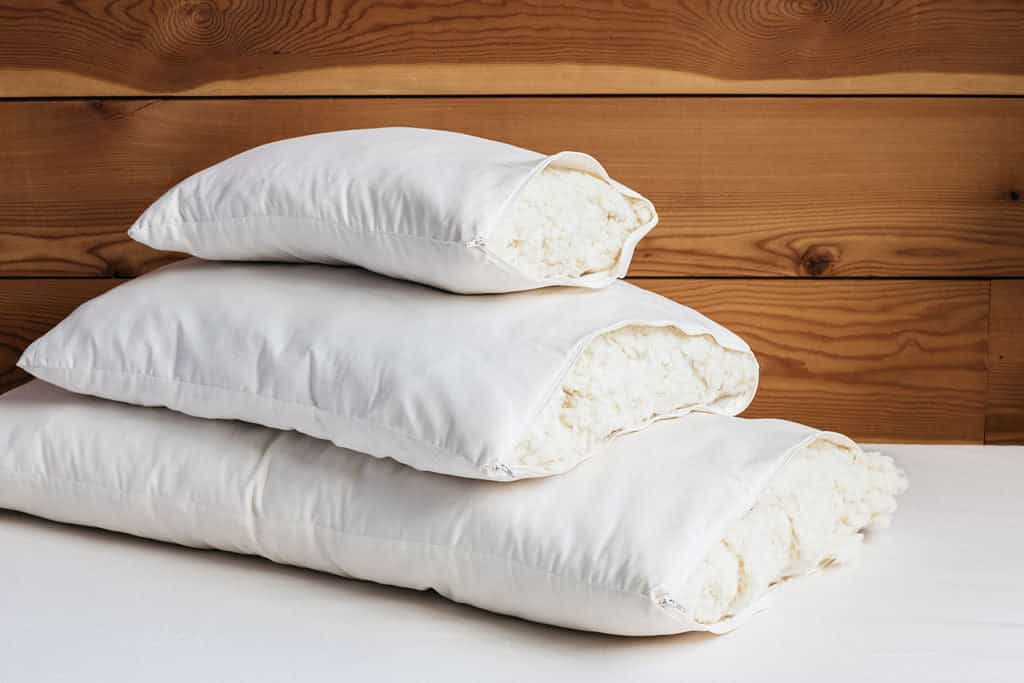
Down is the soft, three-dimensional undercoating beneath the feathers of waterfowl. Its clusters trap air, creating loft without much weight. A down pillow can feel buoyant and pliable: it compresses around the head, then can be shaken or fluffed back into shape. Wool filling, by contrast, is made of crimped fibers that form a springy, more structured mass. It can feel less cloudlike than down, with a degree of resistance that some sleepers find reassuring.
Neither material guarantees a perfect night. A pillow that feels inviting in the hand may not suit the height a particular sleeper needs. The most helpful comparison is therefore practical: how much loft do you prefer, how does your bedroom feel at night, and what kind of upkeep are you willing to do?
Loft: the difference between buoyant and resilient
Loft describes a pillow’s height and its capacity to maintain that height under the weight of the head. It is not the same as firmness. A high-loft pillow may still feel soft if its fill compresses readily; a pillow with less visible height may feel firm if its contents resist compression. For comfort, the relevant question is whether the pillow fills the space between the head and mattress without pushing the neck into an awkward angle.
Down is especially associated with adjustable, yielding loft. The clusters shift as pressure is applied, allowing the pillow to mold around the sleeper. Many people enjoy that enveloping sensation. The pillow may also need occasional fluffing, because the fill can move or flatten during use. A higher fill power generally describes down’s ability to loft relative to its weight; it does not, by itself, determine whether a pillow will suit a person’s body or sleeping position.
Wool tends to have a more resilient, fibrous feel. It can provide a stable cushion rather than the especially pliable sensation of down. Depending on the construction, wool fill may gradually settle with use. This is one reason to read a pillow’s specific care and construction details rather than assume every wool pillow behaves identically. Some designs use layered batting, while others use loose or removable wool fill that can be adjusted.
Examples illustrate the range. The Healthy Choice Organic Wool Pillow is described as a handmade pillow with organic wool batting and an organic cotton sateen cover. It is not adjustable, so its fixed fill is a meaningful consideration for anyone who likes to change pillow height. For a customizable wool option, the Organic Wooly Down Bed Pillow has a zippered case and removable wool puffs, allowing the amount of fill to be tailored. Its filling itself is not washable, while the case can be laundered separately.
Down options also vary. The The Clean Bedroom Union Square Down Pillow is described as an ultra-soft pillow with 650 fill power Hungarian white goose down. The Madison Down Pillow is presented as medium firmness, with 750 fill power down. The Manhattan Down Pillow uses 850 fill power down and a two-inch gusset, a construction detail intended to provide a higher profile. These descriptions are helpful comparisons, but the best fit still depends on a sleeper’s comfort preferences and the pillow’s dimensions.
Sleep position is a useful clue, not a rule
Sleeping position can help narrow the search because it changes the gap a pillow needs to fill. Side sleepers often look for enough height to bridge the space between the ear and mattress while keeping the head from tilting sharply. Back sleepers may prefer a more moderate profile that supports the natural curve of the neck without lifting the chin. Stomach sleepers commonly find a lower, softer pillow more comfortable, since a tall pillow can place the neck at an uncomfortable angle.
These are starting points, not prescriptions. Shoulder width, mattress softness, body shape, and personal preference all influence how a pillow feels. A side sleeper on a yielding mattress, for example, may need a different pillow height from a side sleeper on a firmer surface. People who change positions during the night may value a pillow that can be reshaped or one that maintains a more consistent profile.
Down’s compressibility can appeal to sleepers who want to mold or fold a pillow. A soft option such as the Union Square may suit those seeking a light, yielding feel, while the medium-firm Madison and higher-loft Manhattan provide different starting points within the same broad fill family. Wool may appeal to someone who wants a more substantial or springy sensation, but the exact result varies by fill amount and construction. A fixed-fill pillow is best considered carefully if precise height is important; an adjustable design gives more room to experiment.
Rather than choosing by sleep position alone, notice what happens with the pillow you already use. Does your head sink until the pillow feels flat? Does it feel as though your head is being pushed upward? Do you regularly fold or bunch it? Those everyday clues may reveal more than a broad label about which fill you should choose.
Warmth and moisture: why the bedroom matters
Temperature comfort is personal and depends on more than pillow fill. Room temperature, bedding layers, sleepwear, humidity, and individual physiology all contribute to whether someone feels warm or cool. Fiber properties can influence the microclimate around the head, but no pillow material can guarantee that a sleeper will stay cool or warm in every setting.
Wool is often valued for its ability to manage moisture and for its insulating character. Wool fibers can absorb some moisture vapor while still feeling relatively dry, and their structure can help create a buffer between the sleeper and the surrounding air. That does not make wool a cooling device; a person who runs warm may still find that their bedding or room conditions need adjusting. The Healthy Choice pillow’s wool fill and cotton cover offer a natural-fiber construction, but how it feels will depend on the sleeper and the bedroom.
Down is light and insulating, and the trapped air within its clusters contributes to warmth. A down pillow can feel cozy without being dense, though warmth perception differs from one sleeper to another. The cover and pillow protector also influence the sensation against the face. The Clean Bedroom down pillows described here use cotton covers, but fabric weave and the fit of a protector can alter the overall feel.
If heat is a concern, consider the whole sleep setup before replacing a pillow. A breathable pillowcase, a lighter duvet, and a comfortable room temperature may matter as much as the filling. A crisp cotton percale pillowcase, for example, may feel different from a smooth sateen case, even when both cover the same pillow. Keep the comparison grounded in your own experience: one change at a time makes it easier to tell what is helping.
Care: the label matters more than the material myth
Care is where assumptions can become costly. “Natural” does not necessarily mean washable, and two pillows filled with the same fiber may have different care instructions because of how they are built. Always follow the manufacturer’s guidance for the specific pillow. Washing a fill that is intended only for spot cleaning may damage its structure, while excessive heat can affect covers, stitching, or internal materials.
The Healthy Choice Organic Wool Pillow is listed as spot clean only, with advice to use a pillow protector and avoid direct sunlight or direct heat. That is a relatively low-washing routine: protect the pillow with a washable outer layer, launder that layer according to its care label, and address small marks carefully. Its wool filling is not presented as machine washable.
The adjustable Organic Wooly Down Bed Pillow separates the care of the case from that of the fill. The outer case can be machine washed cold and line dried or tumble dried on low, while the wool fill is not washable. Because removable fill can be adjusted, it may also be possible to remove some puffs before laundering the case, following the product instructions. The separation is useful, but it still asks the owner to handle the fill with care.
Down pillows also require attention to their specific labels. The Clean Bedroom down pillow descriptions recommend a washable pillow protector to help protect the pillow. A protector can reduce the frequency with which the pillow itself needs cleaning, but it does not eliminate the need to follow the manufacturer’s care instructions. If laundering is permitted, drying thoroughly is important; damp filling can remain uncomfortable and may not recover properly. Do not assume that a pillow can be put in a home washer or dryer simply because its cover is cotton.
For either fill, a protector is a practical layer between the pillow and everyday oils, perspiration, and dust. A pillowcase is not the same as a protector: pillowcases are changed frequently, while a protector adds a barrier beneath them. Regular airing and prompt attention to spills can also help keep a pillow fresh. The right routine is the one the care label supports and the household can maintain consistently.
Allergies, sensitivities, and material preferences
People sometimes choose wool or down because of claims about allergy resistance, but a material label cannot diagnose or prevent an individual’s symptoms. Allergic reactions may relate to dust mites, animal proteins, detergents, fragrances, or other factors in the sleep environment. If you have a known allergy or persistent symptoms, speak with a qualified health professional rather than relying on a pillow description as medical advice.
Both the fill and the surrounding conditions matter. A washable protector and regular laundering of pillowcases can help manage dust and surface buildup, but the appropriate approach depends on the person’s sensitivities and the product’s care instructions. Wool’s natural properties and down’s processing or sourcing information may be relevant to a buyer’s preferences, but they should not be confused with a guarantee of allergy relief.
Material values matter, too. The Healthy Choice pillow is described as using GOTS-certified organic wool and an organic cotton cover. The Clean Bedroom Manhattan pillow’s listing states that its down is sourced to the Responsible Down Standard, and the down used in the brand’s pillows is described as tested and certified by the International Down and Feather Laboratory. These are product-specific details worth checking against current documentation if certifications or sourcing standards are central to a decision.
Some sleepers prefer to avoid animal-derived fill altogether; others focus on organic fiber certification, origin, or the feel of the material. The most useful comparison separates these questions: what is inside the pillow, how was it sourced, what documentation is available, and how does the pillow feel in use? No single label answers all of them.
A practical comparison at a glance
| Consideration | Wool fill | Down fill |
|---|---|---|
| Typical feel | Resilient and more substantial; construction determines how soft or springy it feels. | Light, pliable, and compressible; often easy to fluff or reshape. |
| Loft | May feel more consistent, but fill can settle; some designs are adjustable. | Can offer airy loft and moldable cushioning; may need regular fluffing. |
| Temperature | Often valued for insulation and moisture management; not automatically cool. | Trapped air provides insulation; warmth depends on fill, cover, and sleeper. |
| Care | Highly product-specific; some pillows are spot clean only, and fill may not be washable. | Follow the individual label; a protector can help reduce direct soiling. |
| Useful question | Do I want a more substantial feel, and am I comfortable with the stated care routine? | Do I prefer a light pillow that compresses and can be reshaped? |
This is a general guide, not a ranking. Fill quality, amount, chamber design, stitching, cover fabric, and pillow dimensions can change the experience substantially. Comparing a soft down pillow with a firm wool pillow—or the reverse—may tell you more about construction than about the fibers alone.
How to decide without overthinking it
Start with the feel you want. If you like a pillow that gives way, conforms, and can be fluffed, down may be the more natural place to begin. If you prefer a resilient cushion that feels less fluid, wool may deserve a closer look. If your current pillow is too high or too low, prioritize dimensions, fill amount, and adjustability over the broad material category.
Next, consider maintenance honestly. Someone who wants a pillow they can routinely machine wash should check for that exact feature rather than assume it is available in either fill. A spot-clean-only pillow may be entirely suitable for a person who uses a protector and is comfortable with careful upkeep; it may be inconvenient for someone who wants frequent full washing. Product instructions are part of the purchase decision, not fine print to inspect afterward.
Finally, account for the rest of the bed. A mattress that allows the shoulder to sink more deeply changes the distance the pillow must fill. A thick mattress topper can alter alignment. A dense pillow protector may affect the feel. Test the pillow in the context where it will be used, and allow a little time to notice whether the height remains comfortable through a full night.
- Choose by support, not status: a higher fill power or an organic certification does not automatically make a pillow more comfortable for you.
- Check the actual dimensions: standard, queen, king, and specialty sizes can differ, and pillowcase fit can influence how the pillow sits.
- Read the care label before buying: spot cleaning, removable fill, and machine-washable covers are distinct features.
- Use a protector: it can help shield the pillow and make routine care simpler.
- Reassess the whole sleep surface: room temperature, bedding weight, and mattress feel may be part of the problem.
The bottom line
Wool and down offer different routes to comfort. Wool brings a resilient, more substantial character and is often valued for moisture management; its care can be limited, depending on the construction. Down is prized for lightness, loft, and an adaptable, compressible feel, but it may need fluffing and careful attention to its specific cleaning instructions. Neither material is universally cooler, more supportive, or easier to maintain.
Within these categories, the choices are varied. A fixed-fill wool pillow such as the Healthy Choice model differs from an adjustable wool design with removable fill. The Union Square, Madison, and Manhattan pillows from The Clean Bedroom likewise present different levels of softness, fill power, and loft. Those distinctions matter because the best pillow is not the one with the most impressive-sounding specification. It is the one whose height, feel, warmth, and upkeep fit the sleeper’s life.
Think of the decision as a fit test, not a verdict on materials. Begin with the support you need, compare the construction and care details, then consider how the pillow feels in your own bedroom. A well-chosen pillow will not solve every sleep challenge, but it can make the nightly transition to rest more comfortable—and that is a useful place to begin.